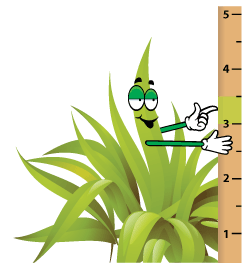
Mowing at a proper height is essential to quality lawn treatment. Mow high, at a height of 3" or greater. Keeping the lawn cut tall encourages a deep hardy root system, maximizing its health and shine. Taller grass shades the soil from ugly weed germination and drying out. Mow at a lush, thick length. Your lawn will be healthier for it.
Improper mowing, at too short a height, is the single biggest cause of unsatisfactory lawn service. Mowing at the right height adds to the health and appearance of your lawn, maximizing your satisfaction with your lawn treatment. Mow too short, and your lawn will suffer. Cut too close to the roots, and you'll be unhappy with ours or anyone else's lawn service. Cut at a healthy height, and you'll enjoy a vibrant, healthy lawn, perfect for relaxing summer evenings with the family.
Mow at the highest height setting possible throughout the entire growing season. Only during the last few mowings of the season (late October and early November) is it acceptable to lower the mowing height to 1 ½.". Give your lawn the height it needs to be healthy. Let it grow thick and vibrant, at a height that will add lush to your lawn.
on Tuesday, 27 January 2015.
Posted in Helpful Tips
Although it may seem odd to find a discussion of mosses included with turf grass diseases, it is true that mosses can be a turf problem and they do spread by means of spores. Thus, there is logic to this placement. Mosses are plants that are usually only a few inches tall, but may reach a height of two feet. Most of them possess leaves and stems, although some are scale-like and result only in flat growth on rocks or trees. Unlike the fungi, all mosses contain chlorophyll and produce their own food through photosynthesis. There are three general types of mosses: the true mosses (Musci), the liverworts (Hepaticae) and the hornworts (Anthocertae).
The liverworts were so-named because they were believed to be beneficial for liver malfunctions. However, the liverworts have no known medicinal value and no mosses have any such value. As a matter of fact, there are probably very few groups of plants that have a lower economic value than the mosses. Only the sphagnum peat mosses show any significant worth. Although mosses grow in nearly every kind of agronomic circumstance, most of the time that they constitute a problem in turf they are found in moist, heavily shaded situations. Furthermore, any additional pressure that makes it difficult for grass to be the major species encourages takeover by moss.
A lack of proper fertilization practices is a good example. The result of damage by moss is very simply displacement of turf. It is usually very difficult to get turf established in areas that have been infested with moss. This is due to the fact that the environmental conditions are more favorable to moss than to turf.
on Tuesday, 27 January 2015.
Posted in Helpful Tips
Moles can tear up the surface of your lawn with their tunnels. They dig through the soil of your lawn, making tunnels and forming mounds as they look for food. Moles can cause extensive damage to your lawn, ruining all you've invested into your lawn service. If not handled properly, moles can quickly colonize across your lawn, spreading their devastation through adjacent residential properties.
Trapping is the most effective method for mole control. You'll have the greatest trapping success in the spring and fall, especially after a good rain. Overwatering your lawn can bring the insects and moles closer to the ground surface, making the tunnels more visible and easy to spot. Harpoon, scissor-jaw and chocker loop traps are especially effective.
A mole problem should be handled quickly. A professional critter control company can stop the problem before it gets out of hand, ruining the smooth beauty of your lawn.
on Tuesday, 27 January 2015.
Posted in Helpful Tips
Turfgrass is a living breathing plant that contains 93% water by weight. Your lawn needs at least one inch of water per week from a combination of rain and sprinkling. When rainfall fails to meet the one inch requirement, you can determine how long to run your sprinkler by placing a tin can underneath your sprinkling pattern and time how long it takes to fill the can a depth of one inch. You can use this measurement, or fraction thereof, to deliver the desired amount each time you water. Proper watering will give your lawn that lush shine you desire, even in the driest, hottest months of the summer.
Soak Your Lawn!
Single, deep waterings in early summer will stimulate the growth of your lawn, allowing for more time between waterings. Water deeply versus too ofter.
Early Morning Timing
Watering after sundown can damage your lawn, as the evening's moist environment and lack of light provide ideal conditions for the growth of lawn diseases (fungus) that can threaten your lawn treatment. It's best to water early in the morning.
Note: Never set your 'Sprinkler System' to automatically turn on. Run your system as needed and 'Soak' the lawn deeply.
Sprinkler Overlap
You should check your sprinklers and irrigation systems regularly to make sure all lawn areas are getting an equal amount of water. The most important technique to remember is to overlap. At each new position, the spray should reach to the previous position. Overlapping ensures that all of your lawn is getting a healthy amount of water. Proper watering techniques will bring out the lushness of your lawn and prevent ugly 'Dry Spots' no matter the weather.
If you follow our advice and you're still not perfectly happy with the vibrancy of your lawn, call us. We'll keep working with you until you are satisfied and content with your quality lawn, or your last treatment will be free. Guaranteed.
on Tuesday, 27 January 2015.
Posted in Helpful Tips
Use your power edger or weed wacker primarily around sidewalks and footpaths. When you edge your lawn, you have two options for which tool to use: You can use an electric or gas-powered edging tool, or you can use a manual edging tool. (We'll explain about the manual edging tool later.) Because you don't have the space to dig out extra mulch or dirt around sidewalks and footpaths, it's best to use a power edger in these situations. Power edgers will make short work of these borders.
- Which should power edging tool you get? Opt for a power edger that is cheap, light, and straight. You can get power edgers relatively inexpensively, and you should — because who wants to spend a bunch of money on an edger? Opt for a light edger because you could spend longer amounts of time holding it up. And finally, unless you feel you need the "ergonomic" option, go for an edger with a straight body; it'll be easier to define a straight edge with one of these tools.
Use your power edger along straight lines and right angles. A power edger is much more efficient than a manual edger, but that doesn't mean that it always gets the job done better. A power edger is great around straight lines, or lines where a raised footpath can guide you. A power edger is not so great around lines where the boundaries aren't so well defined; in these areas, where you want the edge to flow, it's best to use a manual edging tool if you can afford to.
Walk holding the edging tool completely level and rigid. You want your body to move, not your arms. So turn the edging tool on, give it a little bit of power, and start slowly walking with the tool, holding your arms steady. Moving your body instead of your arms will ultimately make the cut on the grass much straighter.
If you can walk on the sidewalk or footpath as you edge. Instead of walking on the grass itself when you edge, walk on the sidewalk or footpath. Here's why. When you hold the edger out with your arms, your body naturally wants to bring your arms back closer to your body. If this happens when you're standing on the lawn itself, you start cutting
into the lawn instead of merely lopping off the farthest edge. Over time, you'll find yourself redefining the edge each time (farther into your lawn) instead of using the same edge as a guide.
- If you're standing on the sidewalk while edging, however, your body's impulse to bring in your arms as you move along the border means much less damage, because you'll be edging air when your body autocorrects. This is an easy problem to fix because it's not a problem at all.
Edge slowly but surely, taking time so that you don't have to rehash the same territory too many times. Power edgers are, well, powerful, so it's tempting to blaze through your lawn in record time. Too often, however, lazy execution produces lazy results. Take your time when you edge using a power tool. You'll find that you won't have to re-edge the same spot over and over again to achieve a clean look. Re-edging the same spot over and over again is likely to lead to a sloppy look.
Get familiar with your half-moon manual edging tool. Your half-moon edger has a large blade in the shape of a half moon with an overhanging lip in the middle of the circle. This lip hits against soil at a uniform level every time you drive the half-moon into the ground, producing an even depth with each edge.
- Simply drive the edging tool into the ground as you would a shovel, down until the lip hits soil, and then pull the handle back gently to dig soil and define your edge. Once you've defined your edges, take a shovel and shovel up any loose soil or mulch into a wheelbarrow.
- When using a manual edging tool, drive the half-moon into the ground completely straight (vertically), not at an angle. Not only will this help define your edge more clearly, but it will also inhibit the growth of rhizomes from growing into the edges of your lawn.
- Maintain your edging tool. Clean off any dirt or debris after each use. File away the edges of the half moon periodically to keep them sharp. There's nothing better than a sharp tool, and nothing worse than a dull one.
Use your manual edging tool to create fluid or flowing edges. Against the slight curve of a planting bed, the edging tool works fantastically. Simply spray paint your curved edge or lay down a garden hose onto the edge you want to create, and edge away. Of course, if you decide to use a garden hose as your guide, be extremely careful not to accidentally cut into it with your edging tool.
Be careful of electrical wires, plumbing pipes, and other subterranean hazards as you edge. Although they may be covered with PVC pipe that's difficult to cut into with an edger, it's better to be safe than sorry. Talk to your utilities company before edging out any large stretch of lawn and remember to edge gingerly.
Edge around flower beds and planters with a manual edge. Flower beds and planters are perfect for using a manual edge because you can afford to take away a little soil or mulch when you edge. The process is the same. Just remember not to take away too much lawn when you edge; try to achieve the balance of taking away just enough to clearly define the edge but not so much that you've significantly reduced your lawn space.
Decide how you want to tackle trees and shrubs. The lawn around trees and shrubs can be edged either with a power edger or a half-moon. When using a half-moon, however, be especially careful of root growth. If the tree or shrub is older or has an extensive root system, consider edging with a power edger instead of actually digging into the soil and potentially cutting up roots.
on Friday, 03 February 2017.
Posted in Helpful Tips
Ever wonder what winterizer is? It's a special blend of fertilizer designed to feed your lawn important nutrients during cool and cold weather. During the late Fall, your grass isn't growing rapidly like it does during the early Fall. Because of cooler temperatures and changes in the sun's spectrum of color, your grass in the Fall slows down its rate of growth, beginning to become dormant. Your grass isn't dead. It just needs a long nap during winter. Like a bear in the winter, your grass goes into hibernation. Winterizer is the food your lawn needs to stay healthy. It maintains the crucial nutrients for next Spring. Adding winterizer to your lawn before the snow hits will build added carbohydrates, giving your lawn the sustenance it needs to develop and survive the winter and wake up fresher and earlier the next Spring.
The difference between your late season fertilizer and Winterizer is the level and balance of nutrients. Apply fertilizer in the late season to take advantage of Fall growth or thickening opportunities. This lawn treatment will still help your lawn keep its lush green, aiding to the health of its roots. As for Winterizer, the lead ingredient is potassium- an essential nutrient that your lawn needs to develop strong cell structure and hardiness for the winter and maintain its health for a bright, fresh start quickly in the Spring.
If you would like to add this beneficial product to the health and beauty of your lawn, ensuring that it will be lush and green early in the Spring when its beauty is just beginning to wake up, give our office a call today.
on Tuesday, 27 January 2015.
Posted in Helpful Tips
Yellow jackets' sharp, lance-like stingers can sting repeatedly. Swarms can quickly overtake unsuspecting children, turning innocent summertime games into traumatic childhood memories. An infestation of yellow jackets threatens the sanctity and peace of mind you've come to expect from quality lawn service.
Yellow jackets build their nests in your home, massing large populations in the search for human food. They infest areas where people live, work and play, becoming a perpetual summer-time nuisance, especially from August through October. The freezing temperatures of November and December kill off their colonies, but the eggs are in place for next year, becoming a perpetual nuisance if not dealt with directly using a professional exterminator.
A typical yellow jacket is ½ inch long, short and blocky, with alternating black and yellow bands on the abdomen. The queen is a bit larger, about ¾ inch long. The workers can often be confused with honeybees. Yellow jackets aren't covered in tan brown dense hair and don't have the flattened, hairy hind legs that bees use to carry pollen. Yellow jackets can sting repeatedly, making them especially a threat to young children and older people. Honey bees, on the other hand, have a barbed stinger and sting only once.
If infestations aren't dealt with properly, yellow jackets can prove to be a dangerous pest, ruining outdoor activities, possibly even causing medical emergencies in the case of the young or very old.
Never leave open cans of soda in areas frequented by yellow jackets. This can lead to deadly throat stings.
on Tuesday, 27 January 2015.
Posted in Helpful Tips